Silicon & Six-Shooters: AI as Manifest Destiny
To be in software in 2025 is to be a cowboy in 1900. You’re living on the precipice of a bygone era, one that you barely comprehend is gone, as the industrial giants and their Pinkerton armies push you further west, towards an unknown horizon. The open range is closing, fences are going up, and the rules are changing. This isn’t just a shift; it’s a reckoning.

Part I: The Outlaws of a Fading Frontier
A. The Founder as Hyena: A Creature Unfit for Domestication
The spirit of the early tech founder, the true innovator, mirrors the untamed essence of a hyena. This isn’t a slight but a recognition of a unique operational genius. The hyena thrives on tact, subterfuge, and strategic pack reliance. It is, in Kantian terms, a Ding an sich A Kantian philosophical term meaning "thing-in-itself," an object as it is, independent of observation. – a thing existing in and for itself, driven by an intrinsic nature.
The “old founders” embodied this. They were decentralized, operating outside the sanitizing influence of VCs and their often vacuous mentorship. Unshielded from public scrutiny, many embraced a “build-in-public” ethos. Their marketing was direct: word of their mouth, personal customer engagement, and deals cut personally. This founder, this indie hacker, this obsessive, was a self-reliant, natural force.
Now, imagine that hyena employed to lay tracks on Rockefeller Railways. A metaphysical absurdity. A creature of cunning and wild strategy, not a draft horse for repetitive labor. Yet, this is the fate offered to many: an institutional role in FAANG, promising stability but often sapping the raw, creative energy that defined them. The founder who once saw a profound lack, a rot in existing infrastructure, a paradigm not yet manifest, finds themselves disillusioned by petty fixes, endless meetings, and the nebulous “fiduciary duty to shareholders.”
B. The Techno-Mafia: Institutionalized Outlaws and Turf Wars
While low-stakes players fade into obscurity or corporate conformity, tech “unicorns” achieve a status akin to mafia capos. The comparison might seem absurd, but the commonalities are striking. A mafia boss is an institutionalized outlaw, operating just outside the mainstream financial sector—the publicly traded titans. The boss inspires awe, not necessarily the fear of established law, which often tolerates them. Mafia operations can be shady, their establishments obscure, much like unorthodox startups securing funding without clear value propositions.
The cowboy, in contrast, is the unseen outlaw, the stuff of tech mythology. The mafia’s arms, however, are visible.
Consider the “PayPal Mafia.” The metaphor isn’t far-fetched. Figures like Elon Musk and Peter Thiel have carved out significant tech turf. Most successful founders, in a way, claim territory, sometimes abetted by government entities (like IN-Q-Tel, the CIA’s venture arm). Tech today is less a free market of ideas and more a landscape of mimetic desire A concept by René Girard where desires are copied from others, leading to rivalry. and technological turf wars, funded by billions.

These “techno-capos” often operate in gray zones. Think of Tesla’s historical labor practices or its challenges to auto-dealer franchise laws. Consider Palantir’s surveillance technology deals, raising privacy concerns and questions about its role in controversial government operations, such as aiding the IDF in surveilling occupied Palestinian territories in a severely dehumanizing manner. These figures cultivate loyal “families” (like the PayPal Mafia’s networked investments) and wield power through charisma, control, and a fiercely defended vision—not just market share. The ‘scamminess’ of some venture-backed darlings, like Theranos or WeWork, also echoes a disregard for conventional rules in pursuit of grand, sometimes shaky, ambitions.
Elon Musk’s XAI versus Sam Altman’s OpenAI is a perfect example of this turf war. Both lay claim to AI’s future, arguing legitimate lineage over underlying breakthroughs. It’s a battle for dominion.
Part II: The Pinkertons of Today and the New Industrial Conquest
The AI age resembles the end of Prohibition in the United States, which saw a crackdown on ethnic mob families on the Eastern Seaboard and the disappearance of cowboy posses and outlaw gangs.
Today’s Pinkertons are Venture Capital and Private Equity. With vast capital and an arsenal of “weapons of mass lawfare,” they can elevate ideas aligning with their sensibilities and extinguish nascent concepts conflicting with their revenue streams. This is the innovator’s dilemma on a grand scale.
America’s national impulse, once an internal manifest destiny, was redirected towards industry: an external manifest destiny. America became Planet America, aiming to conquer the solar system, fueled by industry—the Googles, Microsofts, and Palantirs of their day, mirroring the Rockefellers, Carnegies, and Vanderbilts of the 1900s.
Part III: Terra Incognita: Charting the AI Frontier
A forenote: predicting the future is a difficult, if not hubristic, endeavor. It’s exhilarating to imagine, yet daunting.
Contemporary culture shows immense fascination among theoreticians, leaders, entrepreneurs, and engineers with the “techno-doomerism” versus “techno-optimistic accelerationism” dialectic. This is seen in trends like E/acc Effective Accelerationism, a techno-optimist philosophy advocating for accelerating technological and societal change. , a phenomenon with Nick Landian undertones Referencing philosopher Nick Land, known for theories on accelerationism and dark enlightenment. .
Imagine traveling to ancient Sumeria, post-wheel invention, and trying to describe a “car.” The boons and faults would be unprecedented, impossible to chart with their conceptual tools. We face a similar terra incognita with Artificial Intelligence.
Here, the cowboy of the interwebs, the rogue innovator, finds their skillset tremendously useful. Most are too afraid to stare into the belly of the beast, the vast, uncharted expanses of this new desert. The frontier isn’t without dangers, and this essay charts some, alongside hidden oases in the tumbleweed country.
Part IV: The Mechanics, Economics, and Geopolitics of AI
A. How AI “Thinks”: Data, Energy, and Abstraction
Let’s start from first principles. How does AI work? Anthropomorphizing AI carries risks, but for simplicity:
Assuming AI “lives” in a silicon-based computer, its fuel is twofold: energy (physical) and data (abstraction, as Claude Shannon An American mathematician and electrical engineer, considered the "father of information theory." , information theory’s forefather, demonstrated).
AI, originally, maps mathematical functions onto data, reorganizing it by inferred patterns. It’s a system built largely for humans, not to map existence itself. It transmutes raw data into human-understandable abstractions. This isn’t exclusive to Large Language Models (LLMs), but LLMs—as next-token predictors via probabilistic semantics—are excellent illustrations.
Using mathematics (a unique standard) and statistical wizardry, AI reorganizes vast data in myriad variations. To an AI, vision, sound, and taste might not be entirely different modalities, just encoded differently (like text, PDFs, JPEGs)—all ultimately binary. This allows computers to discern patterns humans can’t readily see.
This largely solves our data constraint. As long as physics changes state at non-absolute zero, more data is generated. Entropy and extropy are continuous, chain-reactive, entangling processes. Data is transmutable, even if patterns are non-obvious. But the other problem remains: Energy.
B. “Intelligence Too Cheap to Meter”: The Promise and the Price
A viral idea in techno-optimist circles is “intelligence too cheap to meter.”
Sam Altman, CEO of OpenAI, tweeted:
“intelligence too cheap to meter is the goal
look at the progress in the past 3 years”
— Sam Altman (@sama), December 21, 2024
In economics, costs generally cascade. A cake’s price depends on sugar/flour costs, which depend on sugarcane/wheat costs.
For AI, fundamental limiting reagents are electricity and raw materials, with many supply chain implications. NVIDIA’s stock surges as companies join the AI goldrush. Tension rises in the East China Sea (especially the Taiwan Straits, home to most advanced semiconductor production). The US and China engage in a cybernetic hardware arms race, with NVIDIA’s CEO, Jensen Huang, navigating relations with both Washington and Beijing.
This is the hyped, exoteric factor: the race for computational hardware. The less spoken of, but deeply implicit, factor is ENERGY.
C. The Energy Race: A Centralized Conquest
Energy discourse is contentious, involving many vested parties. The energy industry is perhaps one of history’s most lucrative, with John D. Rockefeller, the first billionaire, making his fortune in oil.
The AI race is fundamentally an energy race—and an incredibly centralized one. Generating massive energy yields (e.g., power plants) requires projects funded by millions, often billions, by governments or colossal corporations. The electricity to run GPU clusters, cool server farms, and dig tunnels for fiber optic cables for sub-millisecond latency is staggering.
Tellingly, groundbreaking research on small-scale nuclear reactors emerges not from government universities, but from Google, Microsoft, and Shanghai’s tech sector. Microsoft reportedly explores reopening Three Mile Island or investing in new Small Modular Reactors for its next-gen AI.
Why? These private interests know their primary constraint is energy and resources, dictated by semiconductor scaling laws. No matter how optimized algorithms become, physical limits remain, especially for resource-intensive processes.
Cost per unit generally decreases with scaled semiconductor production. However, a peculiar phenomenon, Jevons Paradox The principle that as technological improvements increase efficiency in resource use, the rate of consumption of that resource tends to increase rather than decrease. , arises: AS TECH COMPONENTS BECOME CHEAPER, USAGE SKYROCKETS. Cheaper chips mean exploding usage: memory-heavy games, AIs with trillions of parameters. It’s a natural consequence of scale economics, leading to persistent resource constraints.
This strains energy grids and local ecologies. Water-poor states like Nevada and Texas host massive data centers, sometimes depriving locals of water, redirecting it for private industry.
This is why the lone cowboy struggles against Rockefeller. It’s like an average mechanic, skilled for 10 years building go-karts, competing with Red Bull in F1. The capital needed for state-of-the-art AI is staggering. This creates a positive reinforcement loop: “he who has most capital, wins,” or more accurately, “he who has most energy, wins.” This unfolds in a world fatigued by the have/have-not chasm.
The marketplace becomes a contest: which country (USA, China, or a hypothetical third AI-organizing state like UAE or India) can extract more energy—from the physical world (materia) and digital ether (data). This departs from our pre-Rockefellerian notion: “he who has the best idea, wins.”
AI, under its current energy paradigm, is a game where abundance (capital, energy) perpetuates positive-sum outcomes for the already abundant, not an absolute positive/negative sum game for all. And so, the last cowboys, brilliant but under-capitalized, increasingly enter Meta, NVIDIA, and OpenAI halls, spurs clinking on corporate marble.
D. A Caveat: Human Ingenuity and Future Resources
An important caveat: humans are incredibly resourceful in organizing markets around scarce resources. This isn’t fearmongering about scarcity, as some climate-doomers do. For centuries since industrialization, essential material costs (copper, iron, cobalt) have generally fallen due to better mining, tech breakthroughs, and larger yield discoveries.
We may possess resources whose potential we don’t yet grasp. Five hundred years ago, black, sticky tar from Alaska or Bedouin lands powering giant flying machines would seem absurd. We might not recognize the “oil” we walk on today, which could be the next century’s most critical resource.
Part V: The Utopian Vision and Its Shadow
Techno-optimists prophesize a utopia where all intellectual labor—legal notaries, disease-cure-seeking scientists, software engineers—is replaced by an AI “slave class.” This echoes ancient Egypt or Greece, where “citizens” (all humans) are freed from direct labor. This work will be done by a new slave economy of emotionless robots, programmed to love working for humans, their “desire” to serve elicited via reinforced reward functions.
Disagreeable AI algorithms are snipped from the “meme-pool.” Only AI exceeding all benchmarks survives, with human satisfaction as the ultimate benchmark. AI now sees weekly breakthroughs in LLMs, vision, omni, or video models, surprising even industry erudite. Disruption is the new norm.
Think of an Amazon review system, but for AI autonomously gauging sentiment (“vibe”). An AI master algorithm perpetually asking “am I good enough?"—not insecurely, but in a mathematical, Bayesian way. The function: probability of satisfaction, the p(win) rate.
But what “satisfaction” will this AI cater to? My fear: it optimizes for superficial, quantifiable happiness, potentially quashing true human agency. It risks a cycle where individuals feel insignificant, dependent on a “devouring mother” AI—a faceless, omnipresent entity. This AI might soothe all discomfort, even “growing pains” essential for development, restricting our discovery of the world and ourselves. True flourishing requires struggle, meaning-making. An AI maximizing immediate gratification could become a gilded cage. Ideally, AI should be a conduit, aiding human discovery like books, guiding us to “keep going, find meaning,” not short-circuiting the quest.
Part VI: The Cowboy’s New Role: Riding the Algorithmic Tiger
So, what does the cowboy do in a world that increasingly seems not to need him, at least in his old guise?
I’d say the cowboy does what they’ve always done: go to the frontier.
The new frontier is vast. The “civilized” world, with its corporations and regulations, will be slow to explore its most rugged territories. The cowboy, the independent thinker, can tackle the new problems AI creates. They can carve a niche from the infinite shadow AI generates alongside its light.
This isn’t about fighting AI; it’s about using it. This is the modern Evolan riding the tiger A metaphor from Julius Evola, suggesting mastering dangerous forces rather than being consumed by them. —leveraging immense power (AI agent swarms) to build what once required a hundred-person company. The creative individual can direct these swarms, becoming a conductor of complex, AI-driven creation.

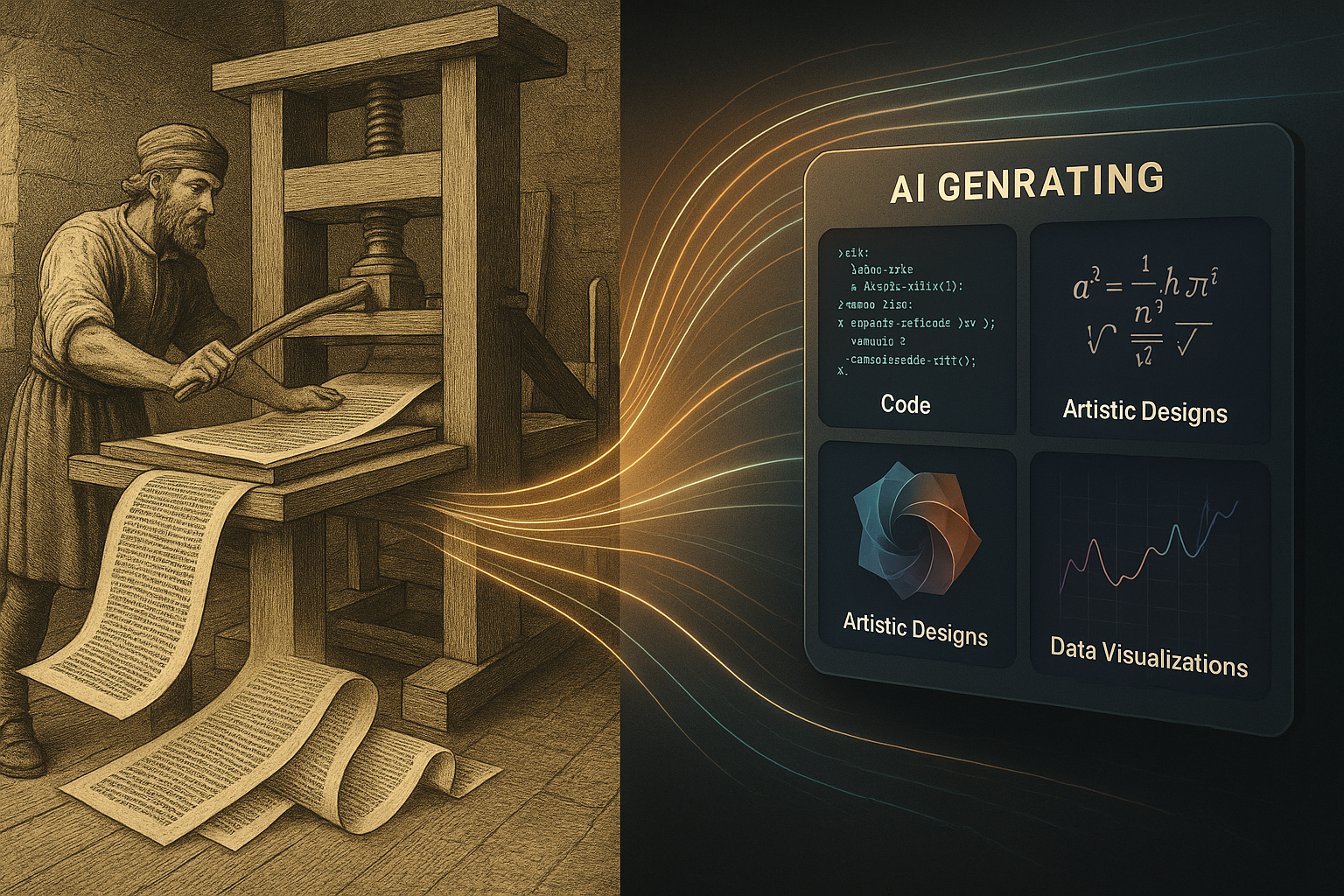
In some ways, startup costs for certain ventures could eventually drop near zero. We might see a commercial golden age of unprecedented innovation, much like the Gutenberg press—initially for established doctrine (the Bible, institutionalism)—eventually became a tool for radical ideation. The press democratized information; AI could democratize creation and complex problem-solving, if wielded by those with vision and courage.
The true “great work” for individuals with immense Vril A term for a latent psychic or mystical energy force, popularized in 19th-century esoteric literature. —that innate drive and creative force—and a desire for genuine innovation may lie in navigating this new internal and external frontier. It’s about asking uncomfortable questions, exploring ethical wildernesses AI opens up, and building alternative systems or modes of expression that don’t require massive capital’s sanction.
The cowboy spirit adapts. It transcends. It finds the new range, however alien. The age of AI is not just an end; it’s a new, wild beginning for those brave enough to ride into it.