Feeding the Hydra: Musings on Cyberslavery
Clarity.
All we seek is clarity. Yet, it appears that everything around us – everything we see, everything we touch – is designed to be noisy, to disrupt every thought we have before it can fully form. Entire teams of researchers, scientists, psychologists devote their lives to finding and “pulling the right” switch in our minds, optimizing for engagement, for distraction.
Our inherent capital – the finite time and vibrant youth we possess – is systematically siphoned off to feed the mainframe, the ever-hungry digital systems that thrive on our attention.

The Great Hollowing: Digital Selves, Diminished Depth
In many ways, we become less of ourselves in the physical world. We pour more individuality, more curated life, into our internet personas than into our real-life relationships. We feel closer to internet friends, creators, influencers we’ve never met than we do to our own neighbours, cousins, even close friends and relatives. We are, paradoxically, more alive on the internet than we are in real life.
It’s as if the whole purpose of eating, sleeping, working – the very fabric of physical existence – is merely the required maintenance to get back online, to document our activities, to upload our lives to the cloud. Our most mundane thoughts, fleeting moments, and constructed simulacra are transmogrified into lurid, filtered, hyper-edited images and bite-sized updates for public consumption. Complex, vivid realizations are reduced to the character limit of a tweet.
And beneath this surface performance, our thoughts, our clicks, our unconscious utterances feed the Hydra – the vast network of algorithms that always listens, is always aware, learning more about our patterns and desires than we know ourselves. Every interaction, known or unbeknownst to us, becomes food for this entity.
For the youth, the Zoomer generation in particular, this simulation isn’t something adopted; it’s the environment they’ve known since they could crawl. A generation practically raised by the internet. The effects, potentially disastrous, may not be fully understood for decades. We see symptoms: the pervasive phone anxiety, the dread of being disconnected; the FOMO that grips us if we miss a week of scrolling X or Instagram; the feeling of tribal excommunication for not participating in the meme economy of the group chat. We substitute true intimacy with easily accessible dating apps or its abstractions, objectifying ourselves and others based on the shallowest of qualities.
Overall, it’s a pervasive lack of depth.
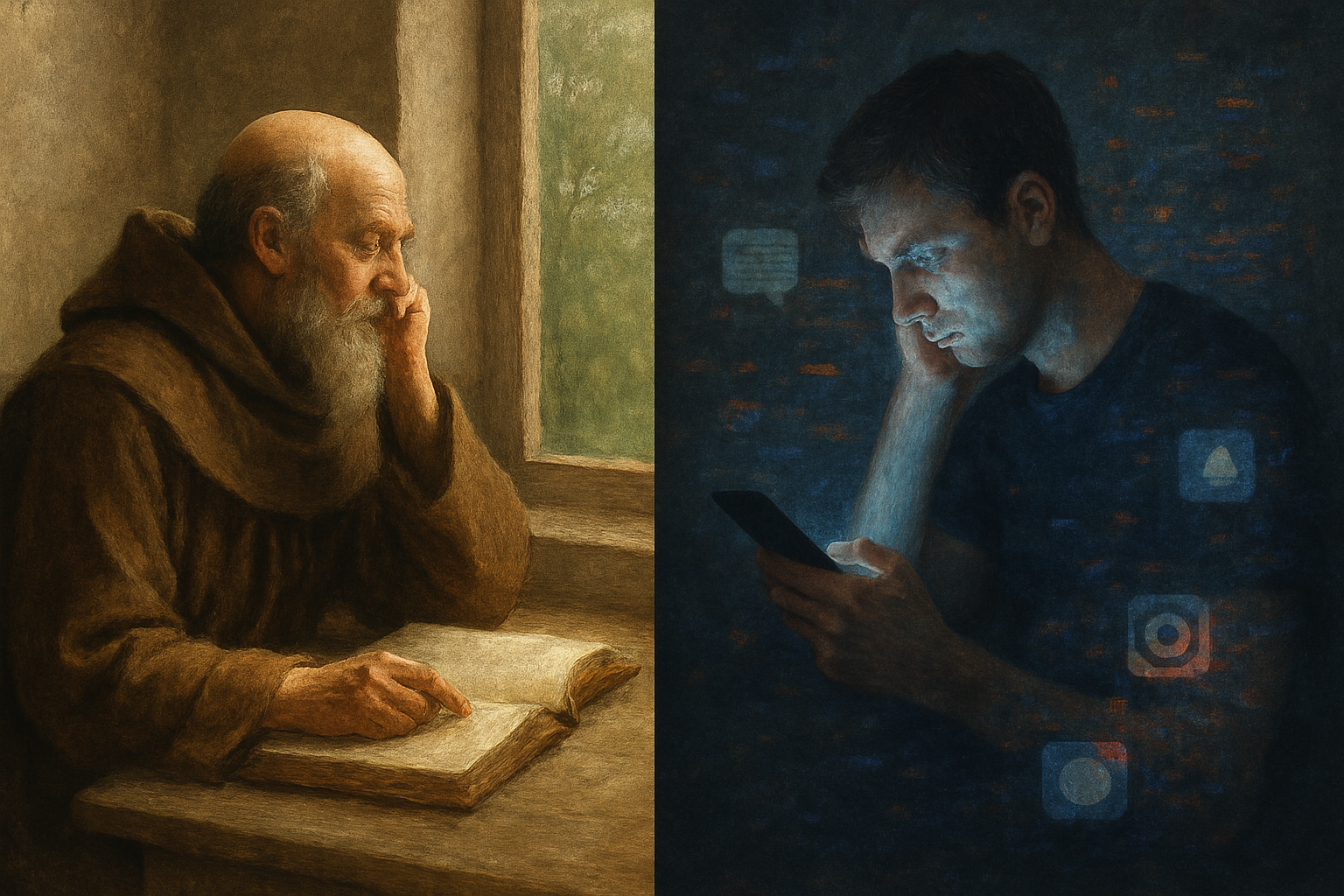
The Lost Art of Contemplation
This lack of depth stands in stark contrast to our ancestors. They were deeply attuned to a different rhythm. In an age devoid of blaring podcasts, TikToks, or instantly gratifying reels to quell boredom the moment it arose, they spent enormous chunks of their waking hours – both actively and passively – in contemplation. Thinking about the world, about God, about themselves, about the nature of their relationships, about art and meaning. They were a more concrete part of nature, eating from it, sustained by it, embedded within its cycles.
Now, we’re sustained by faceless machinery. An abstract system without a concrete soul, a physical center. Its presence is paradoxically all-encompassing, touching everyone through invisible rays jetting through the air, yet it cannot be touched by a single person. It’s a snowball rolling down a hill – constantly consuming, growing larger, accumulating more vectors to optimize whatever function it’s crunching out of each individual human being: their dopamine, their energy, their money, their debt, their love, their devotion, their awe, their righteousness… and ultimately, perhaps, their soul.
Agency: The Tool and the Trap
The answer, the potential antidote to this drift, is agency.
Technology was historically envisioned as leverage for a person, a tool to help that person achieve their goals and enact their vision upon the world. The knife is a simple, profound example. Without it, early humans struggled to hunt, harvest, build. The axe and the knife extended the human, giving an otherwise vulnerable, hairless bipedal oddity enormous control over its surroundings.
The emphasis is crucial: control over surroundings. This isn’t about playing a solipsistic game where the only agency lies within oneself, tinkering with internal states – a potential misreading of certain liberal ideals aiming only for maximized self-pleasure within a contained box. No, the truly agentic vision is that a human being, with tools at their disposal, is able to shape the world.
The ideal? One exploits tools, not other human beings.
For millennia, most tools were “dumb.” They required human intelligence and effort to enact lofty goals. Conquering territory needed soldiers. Building vast businesses needed employees. Constructing pyramids supposedly needed slaves. From almost any perspective, it’s easy to see how this necessity – achieving desires through the forced effort of others – has inflicted harm. Perhaps forcing other beings to suffer for our goals is inherent human nature, perhaps not.
But the modern era presents a terrifying twist. The technocrats – the Thiels, Musks, Zuckerbergs, Altmans of the world – pursue their ambitions by consuming vast amounts of data generated by humanity. Our interactions, our preferences, our most intimate secrets become fuel, infused into closed-source, Frankensteinian machines that few can peek into, let alone audit. Shielded by legal loopholes and complexity, accountability evaporates.
The Crossroads: Destruction or Positive-Sum Futures?
This is a bleak turning point, a crossroads.
We can continue the cycle of destruction, of adharmic malevolence (acting against natural or cosmic order), inflicted upon each other and the planet, amplified by these powerful new tools.
Or, we can consciously, deliberately FOCUS on building “positive-sum” games. Creating tools aligned with our best nature, designed to elevate human potential rather than exploit our weaknesses. There is immense beauty in humanity – our curiosity, our resourcefulness, our capacity for connection. These qualities can be channeled towards incredible ends, many we likely can’t even imagine yet.
It all comes down to the choices we make, the difficult, intentional choices required in the coming years.
The Question of AI: Bearing Sins or Birthing Tyrants?
This brings us to the crux of technology’s evolution: Artificial Intelligence. Could AI, standing at this technological precipice, potentially bear the weight of humanity’s “sins”? Our relentless drive for exploitation, our compulsion to extract every last drop of “productivity” from an entity – akin to forcing a donkey to grind millet endlessly, or an employee to take extra shifts for the next product release. Could AI absorb the burden of what we’ve historically called “human progress,” freeing us from enacting that exploitation directly?
The answer is terrifyingly unclear. Maybe.
It likely depends on whether our own shadow nature – our deep-seated need for power over each other – hijacks the process. There may come a point where AGI surpasses human intelligence, flipping the script, turning the exploiters into the exploited. But predicting that trajectory, with its infinite variables, is beyond our scope here.
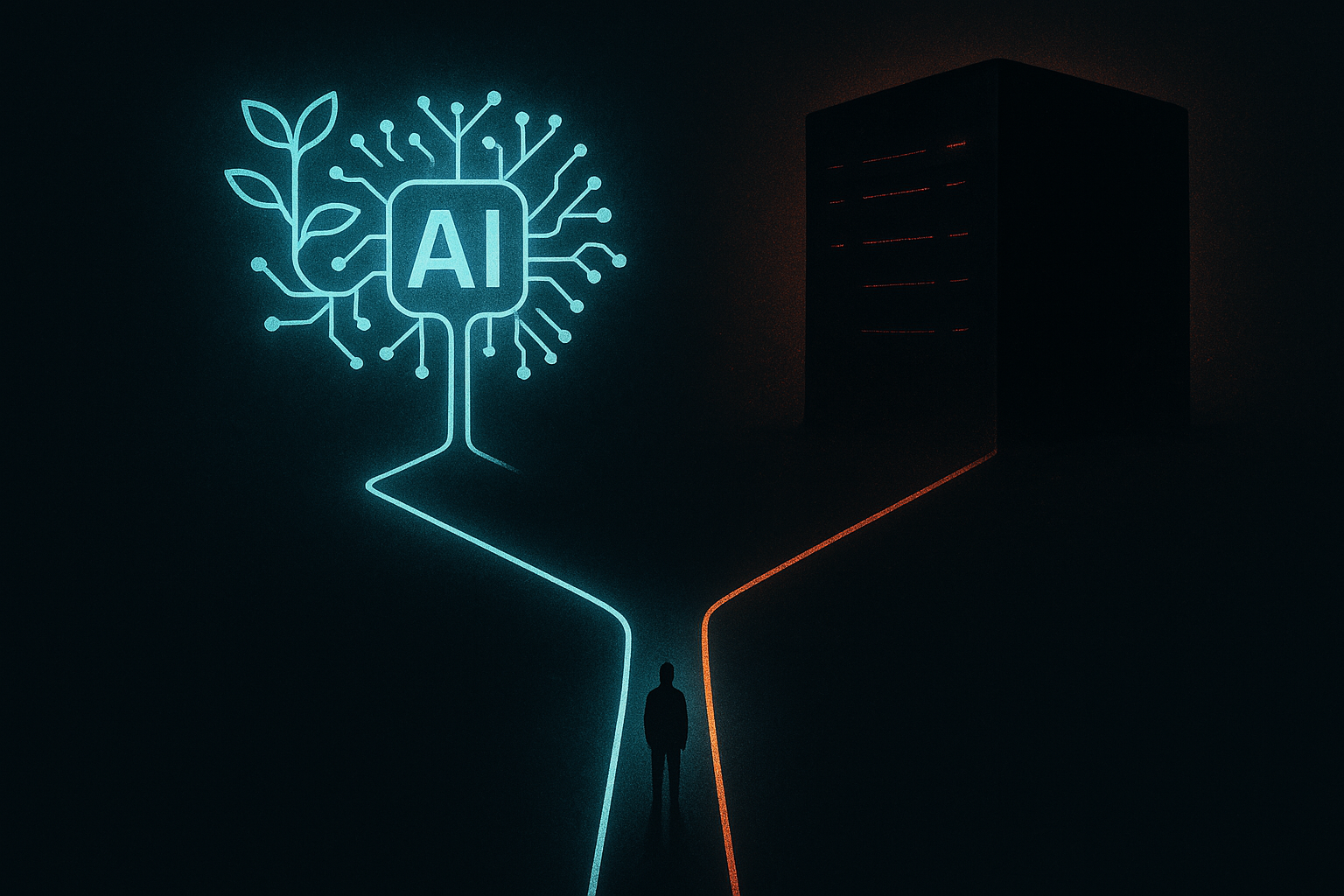
The immediate, pressing question is this: Will the smartest machines be built “FOR THE PEOPLE,” or for the emerging technolygarchy?
Will the visionaries of our generation build systems that are open-source, auditable, designed to meet collective needs, perhaps even raise consciousness – aligning AI with the goal of helping every human being achieve their potential and destiny?
Or will the alternative prevail: where those who own the means of computation, the energy resources, the capital, use AGI to entrench their own power, prioritizing their needs over the collective well-being?
My trust in the current elite types – the Musks and Altmans – is thin. They have consistently prioritized the health and growth of their own ventures, often at odds with broader global or societal health. It’s undeniably bleak that they are the ones currently developing the frontier models.
It will likely take a new generation. A generation with SKIN IN THE GAME. Those who will feel the full brunt of the AI revolution – its profound uncertainties and its dazzling potential – to forge a different path.
My current focus leans towards open source. It feels like a fundamental travesty if people cannot understand, contribute to, or audit the algorithms that increasingly govern their lives. Perhaps open source alone isn’t enough; perhaps it’s a system that can still be gamed.
But before we can find solutions, before we can even fully grapple with the alternatives, we must start asking the question. Loudly. Persistently.
For you can’t find an answer to a question that isn’t even being seriously discussed.
Clarity. Perhaps the first step towards it is acknowledging how much of it we’ve lost, and demanding the space to seek it once more.